
Placement Test Topics
Placement Test Topics
After submitting the signed application form with the required documents (Category A), the Admission’s Office will fill an EPT (Electronic Placement Test) Reservation form to be scheduled as per university calendar.
English Placement Test Topics
1. EPT Grammar Skills Requirements
Parts of speech:
1- Nouns: gerunds, countable/uncountable,
- Swimming is fun.
- There is so much water in that lake.
2- Verbs: regular/irregular, action/state, infinitives
- All tenses: simple present, present continuous, present perfect, present perfect simple, past, past continuous, and future
3- Adverbs- modals,
4- Adjectives: more, most, many, comparatives, superlatives, present participles, and past participles
5- All Pronouns: anyone, subject, object, reflexive, possessive, (other, another, the other), and relative …
6- Indefinite Pronouns: All, some, any, several, anyone, nobody, everyone, each, both, few, either, none, one and no one
7- Demonstrative pronouns: this, that, these, those
8- Prepositions
Conditionals
- Correct: If I were you, I would tell the truth.
- Incorrect: If I was you, I tell the truth.
Use of:
- Used to
- Despite- in spite of
Sentence structures:
- Not only…but
- The more…the more
- Never + verb + pronoun
Parallelism:
- Correct: I woke up, got dressed, and went out.
- Incorrect: I woke up, getting dressed, and went out.
Embedded questions:
- Correct: Can you tell me what the time is?
- Incorrect: Can you tell me what is the time?
Mistakes commonly made by francophone students
- Correct: This book offers very interesting information
- Incorrect: This book offers very interesting informations
2. EPT Reading & Listening Skills Requirements
1- Identify audience and purpose of a text
2- Use context clues to determine the meaning of unfamiliar words and expressions in reading materials
3- Identify main ideas and supporting details
4- Identify organizational patterns of texts
5- Draw inferences based on information presented in the text
6- Identify author's tone
7- Identify bias in texts
8- Match synonyms and antonyms
9- Explain analogies
10- Answer factual questions about the text (who, what, when, where, how)
11- Answer inferential questions about the text
12- Distinguish fact from fiction
13- Distinguish fact from opinion
14- Identify the most important or relevant information from a reading selection
15- Compare/contrast characters, events, ideas from reading selections.
16- Compare/contrast characters, events, ideas from reading selections to real life
17- Explain cause and effect relationships from reading selections
18- Retell events from a story in sequence
19- Interpret implied meanings.
20- Explain metaphors and similes found in reading selections
21- Identify text structure in nonfiction selections (cause/effect, sequence, compare/contrast)
3. EPT Writing Skills Requirements
1- Avoid sentence fragments, faulty parallelism, dangling modifiers, comma splices, wordiness, redundancy
2- Write effective topic sentences
3- Write effective concluding sentences
4- Write effective introductory and concluding paragraphs
5- Write an outline
6- Write a five- paragraph expository/persuasive essay
7- Write a stated thesis statement
8- Support ideas with relevant details and explanations
9- Follow a logical sequence in presenting ideas
10- Use smooth transitions between ideas (within and between paragraphs)
4. EPT Speaking Skills Requirements
1- Talk about likes and dislikes
2- Compare two things
3- Talk about jobs
4- Talk about the weather
5- Restate the main idea and incorporate the most important supporting ideas and details
6- Construct an oral summary
7- Use limited transitions of addition, sequence, exemplification, comparison/ contrast and clauses introducing opinion and fact
8- Initiate and continue a conversation
9- Answer basic questions on personal and concrete topics
10- Use formulaic expressions such as greetings, making polite requests and leave-taking
11- Produce sentences with appropriate word order in the main clause.
12- Produce coordinated clauses with appropriate word order
13- Produce some complement clauses (think/say, want/like)
14- Produce adverb clauses of reason (because)
15- Produce sentences with correct tenses
Biology Placement Test Topics
Biology Topics Required For BPT (Biology Placement Test):
Some grade eleven topics and (same topics required officially for grade-12 -life science section).
From Grade Eleven- scientific section:
-Karyotypes
-Mitosis
-DNA and RNA Structures
-DNA Replication
-DNA Transcription and Translation
-Blood Types- Blood transfusion
From Grade Twelve - life science section:
Part I: Reproduction and Genetics
-Karyotypes
-Mitosis
-DNA and RNA Structures
-DNA Replication
-DNA Transcription and Translation
-Blood Types- Blood transfusion
Chapter One: Basic Mechanisms of Sexual Reproduction:
-Document one: Male and female reproductive systems
-Document two: Diploid and haploid cells
-Document three: Meiosis
-Document four: Spermatogenesis
-Document five: Oogenesis
-Document six: Fertilization
Chapter Three: Genetic Variation and Polymorphism:
-Document one: Mutations and the environment
-Document two: Mutations and multiple alleles
Chapter Five: Human Genetics
-Document one: Inheritance of genetic traits
-Document two: Autosomal diseases
-Document three: Sex- linked diseases
-Document four: Chromosomal mutations -karyotype anomalies
-Document five: Prenatal diagnosis
Part II: Immunology
Chapter Six: Role And Components Of The Immune System:
-Document one : HLA: a major self- maker
-Document two: Blood groups: another self- maker
-Document three: The non- self
-Document four: Cells of the immune system
-Document five: Lymphoid organs
-Document six: Antigen recognition by B lymphocytes
-Document seven: Antigen recognition by T lymphocytes
Chapter Seven: The Immune Response
-Document one: Non- specific immune response
-Document two: Specific immune response
-Document three: Induction of the specific immune response
-Document four: Role of TH in the specific immune response
-Document five: Specific humoral immune response
-Document six: Specific cell- mediated immune response
-Document seven: Immunological memory
Chemistry Placement Test Topics
Chemistry Topics Required For CPT (Chemistry Placement Test)
Note that these subjects can be found in the Lebanese official chemistry books for grades 9 to 12 (scientific sections)
- How to calculate the number of sub-atomic particles (protons, neutrons, electrons) in an atom or ion using the periodic table.
- Use simple formulas to calculate: number of moles, mass, molar mass, concentration, volume, number of atoms, Avogadro's number, volume, molar volume.
- Precipitate formation and precipitate colors
- Stoichiometry
- Balancing equations
- Criss- cross method
- Alkanes- alkenes- alkynes/names and formulas only
- Families and their properties in the periodic table
- Hydrogen bonding of water molecules
- The diagonal rule for electron configurations
- Dilution
- Acid-base titration
- Le Chatelier's principle/in general
- Valence electrons and valency of atoms
- IUPAC names of organic compounds
- Functional groups in organic compounds
NB: Student should bring his/her calculator and pen, he/she will need them at the test
Mathematics Placement Test Topics
Remedial Math Program
Math Placement Test
The Math Placement Test (MPT) is a computer based test required from applicants to the following majors:
§ MPT-1: Business Administration (Accounting, Human Resource Management, Marketing, Management), Management Information Systems, and Health Management Information Systems.
§ MPT-2: Computer Science, Information Technology, and Math/Science Education
Remedial Tracks
Based on the Math Placement Test results, the student might be required to follow one of the following Math Remedial tracks:
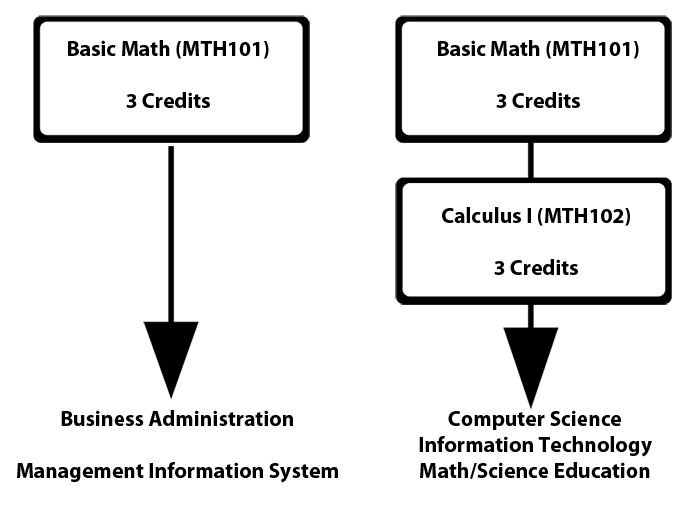
MPT Formats
MPT-1 20 MCQ, Total time: 30 minutes
MPT-2 60 MCQ, Total time: 90 minutes
Topics of MPT-1
Section 1:
1- Basic Arithmetic (operation on fractions, powers, radicals)
2- Polynomials (reduce, factorize, find roots, remarkable identities)
3- Algebraic expressions (evaluate)
4- Equations of first and second degree
5- Inequalities of first and second degree
6- System of equations
7- Word problem involving one or two unknowns
8- Functions (graph reading)
9- Percentages (increase, decrease)
10- Average of data set
11- Area and perimeter of regular shapes
Topics of MPT-2
Section 1 & 2:
All material of section 1, in addition to:
1- Pythagoras' theorem
2- Trigonometric functions
3- Equation of lines (slope, relative position, x- intercept, y-intercept)
4- Functions (domain of definition, limits, derivatives, variations, extremum)
5- Logarithmic functions
6- Exponential functions
7- Antiderivatives
8- Numerical sequences
On the Test Day
Applicants should be present 30 minutes prior to the test. They are also required to bring the MPT reservation form signed by the registrar, a pencil, and a calculator. Scratch paper will be provided in the testing room.
Placement criteria
| Test | Grades | Remedial to be placed in |
|---|---|---|
| MPT-1 One section: 20 points | 12 and above | No remedial |
| below 12 | MTH-101 | |
| MPT-2 Section 1: 20 points & Section 2: 40 points | Section1: Less than 60% (12/20) | MTH101 |
| Secton2: Less than 60% (24/40) | MTH-102 |